 Arcadian Prairie
1925, your name is Thomas D Campbell. You are standing in your office, leaning over your desk. Hardin Montana is where you call home. You look at the prospect of harvesting 30,000 acres. An impossible task 20 years ago. The past 2 years you have lost money, your investors who include Wall Streets finest like the merchant banker JP Morgan decide they should cut their losses and shut down the Montana Farming Company.
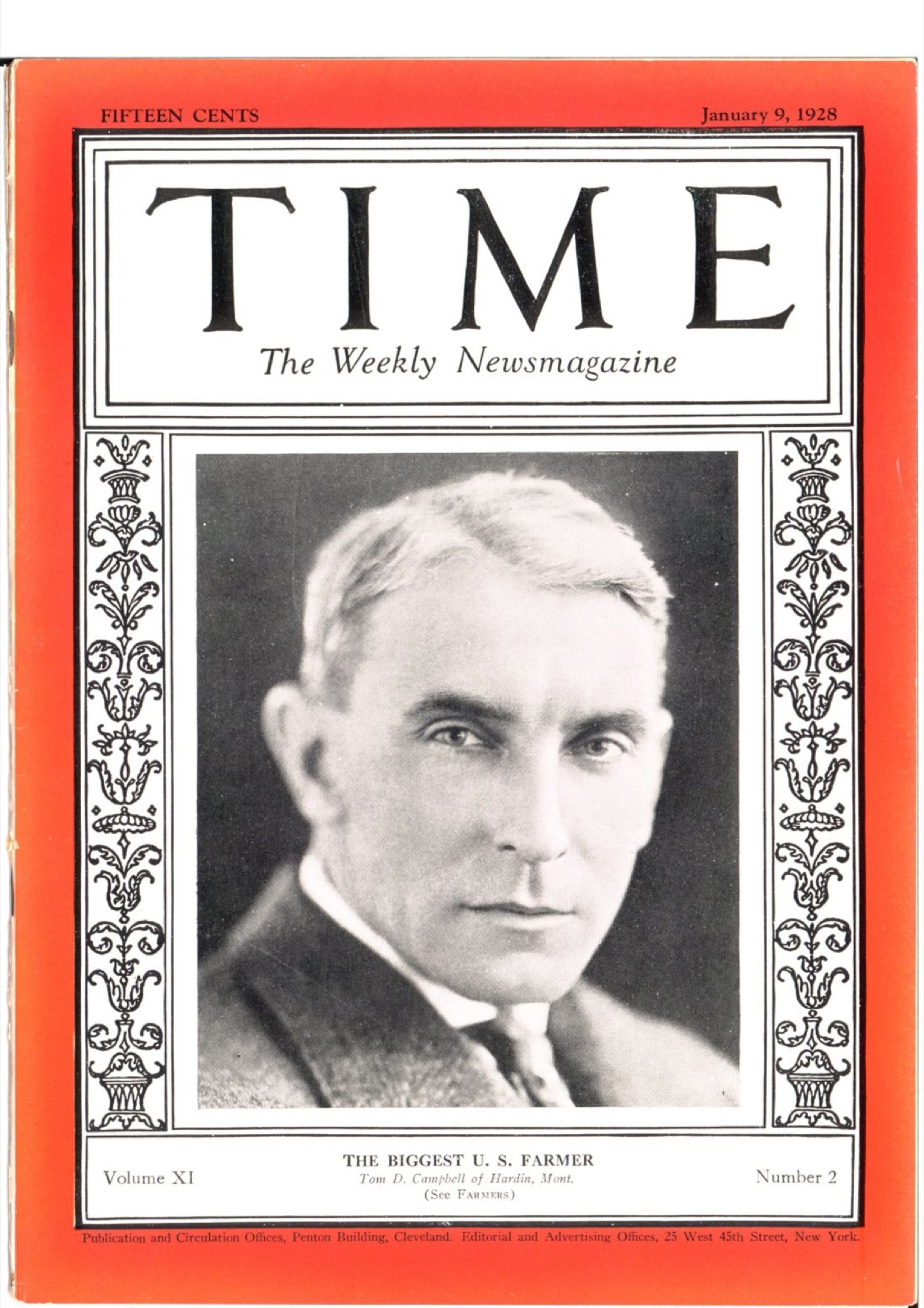
Time Magazine in 1928 said it best, The biggest farm in the world, run analogously to Henry Ford's factory, is the wheat farm of Thomas D. Campbell.
You know the idea of an industrial farm spanning 100,000 acres will work. You bet your life on the concept. You now own the Campbell Farming Company. The reincarnated Montana Farming Company, now primarily owned by you but financed on other peoples dime. This has to work. You have no other option. The Farm as a Factory (see Fitzgerald) is the future. You see it, now you must make the future a reality.
The Futurist
Thomas Campbell saw what no one else saw in the 1920s, a world dominated by mega farms spanning 10,000s of acres. While the rest of country continued to fight for the ideal of the small farm America, Thomas had seen the great ranches of California, he knew that the future was cost optimized production at scale. 2026, nearly 100 years later, his vision has become reality in much of the world.
Thomas D Campbell was born in Grand Forks ND, a central part of the Red River Valley, an area during the time period dominated by the "bonanaza farm boom". Then and now the region is known for innovation, scale, diversity and phenomenal farming.
Thomas was born into a wheat farming family but never considered himself a farmer, he was raised a farm kid, but knew he wanted to be more. He was an engineer and industrialist at heart. This took him to University of North Dakota for an engineering degree and later Cornell for post grad studies.
Due to his fathers ailing health he dropped out of Cornell and came back to the farm. Shortly after that he met his wife, daughter of the man who invented Cream of Wheat. A few jobs later and with his wife and mother coming down with tuberculosis, the remedy prescribed was a move to California.
Here Thomas began a job managing a 100,000 acre ranch in California that probably cemented the idea that his destiny was to build the ultimate industrial farm. The future has been seen.
- Grand Forks, ND. Engineering degree (UND, Cornell postgrad). The pivot from engineer to farmer.
- Constraint: no more than 3 biographical facts here. Resist genealogy. Colossus cuts childhood to the minimum needed to explain the adult's obsession.
4. The Founding Bet (300–350 words)
A few years pass and war has descended upon the world. Food shortages are a major fear and crisis could be only a drought away. Campbell knew it was his time to act.
Thomas set out to find the people in charge who could get him that land he needed to farm at scale, not only to realize his dream but also to meet a realtime war need. Through a couple dead ends, Thomas finally wired the president, Woodrow Wilson, directly seeking to gain leases on native american reservations.
Wilson was down with the idea so now things were in motion. Now the money needed to flow in. Through Thomas's previous employer he was able to build a relationship with Wall Street bankers, most well known among them being JP Morgan.
Once the scale of the farm increased, the need for money increased as well. For this Campbell was able to depend on his connections. J. S. Torrance’s busi- ness relationships with J. P. Morgan and Louis W. Hill (president of the Great Northern Railway and well known by the large-scale farmers in North Dakota and Montana) helped Campbell secure an interview with Morgan that resulted in a promise of $2 million from Morgan and other New York bankers.
-Deborah Fitzgerald
The money was secured, Campbells vision was cast and it was eaten up by the bankers.
According to Campbell, Morgan was taken with the idea for more than strictly economic reasons. “Young man,” he said to Campbell, “your project is the most romantic, the most patriotic, the most interesting and, I believe, one of the most profitable ideas that has ever been presented to me.
-Deborah Fitzgerald
The world is looking good for Thomas Campbell. Nearly 100,000 acres under contract leases. 2 million borrowed from the top folks in the country. Now time to put it in to action.
Thomas bought large state of the art, tractors, binders, threshers, grain trailers, and start assembling a work force to accomplish the monumental task.
And he did just that. He pulled off the dream of farming a 100,000 acres. Now some of it was fallowed every other year or every third year so it wasn't 100,000 constantly but nonetheless that was a lot of land to manage even by todays standards.
The problem 19:18-1921 were almost total crop failures. The bankers wanted out. Time to cut their losses.
So now here somes the great salesmen. Thomas convinces JP Morgan to let him buy out the other investors (including Morgan himseld) with money borrowed from JP Morgan. For about 17 cents on the dollar compared to the initial investment.
Campbell just financed the sale of the largest farm in the US to himself for nearly a 1/5th of its original value.
Maybe it was planned out. Maybe it was calculated. Maybe it was all luck. Regardless, Campbell's vision couldn't be hampered.
5. The Machine (350–400 words)
Some day there will be a farming organization comparable in size to United States Steel or General Motors, for food is the most necessary commodity of all.
Now Cambell finds himself with his dream in front of him. The industrialized farm he had the vision for, ready to move the world.
Now what happened from 1921-1927 is parse for avaivlble sources but one can only assume that trial and error had it's way and the Campbell persisted atleast sustainably enough to not go bankrupt.
We fast forward to 1928 and get an article in Time Magazine with his face on the cover photo. We get this snapshot into his world. At that time he had:
- 56 tractors
- 500 plow bottoms
- 21 combines
- 31,000 acres of wheat in production
- 7,000 acres of flax in production
Thomas Campbell, farmer, engineer, visionary, on the cover of Time Magazine with the subtitle "Biggest U.S. Farmer".
The vision in full motion. A farm on par with US Steel or General Motors. A wheat farm like an assembly line producing crops as efficiently as possible.
All brought to be by a man who from my research had an obsession with a vision of the most efficient farm possible, unmatched in scale, bringing significance to an industry often looked down upon by the large corporations of the day.
I see a man with vision and an unstoppable will to see it come to be.
6. The Turn — Russia (350–400 words)
This is not meant to be an exhaustive biography of a man, this is meant to serve as a window into a legend in the agriculture industry that I think deserves some more publicity.
But some final notes worth mentioning:
- Thomas Campbell was quite the PR man, and in his hey day was probably a few steps away from a household name for many within agriculture. Enough of a name to be brought on to advise the Soviet Union on collectivizing and running the massive farms of Soviet Russia. Sources argue that this may have just been for money to help keep the farm afloat, which may be partially true but here I see the opportunity for the farmer of scale to witness farms of a nation that would more or less try to create a million acre state run farm. Was there money involved? For sure, was that the main motive? I doubt that.
- The Campbell Farming Company did slowly decline in size but still remained the largest operation until Campbells death in 1966.
- Campbell would later go on to own large tracts of land in New Mexico as well. Some of it was used in agriculture production but some was also dedicated to development.
- During WW2 Campbell helped advise mechanization and transport of military vehicles.
Now on to the meat of what I have discovered about the "Wheat King of the World".
Thomas Campbell saw something no one else saw during his time: agriculture will become large and industrialized much the way of factories had in the decades prior. Now whether he was a prophet seeing it coming or the change agent that helped spur it on, we can look back 100 years later and see farm operations in the great plains spanning 10,000s of acres. Every year they become more and more common. Scale and efficiency now define much of the modern agriculture industry.
Second, Thomas may have seen the future but it was instilled to him at a young age:
I learned as I grew older that farming was the oldest business in the world, that it had survived and continued to grow under most unfavorable conditions, and I felt that if it were possible to apply the ideas which were used in other industries, farming too could be made successful.
My parents were progressive farmers. We had the first steam threshing machine in the Red River Valley.
I have seen time and time again through my reading of legendary agriculture figures, they always adopt technology long before it was standard. They see innovation that will scale one day and adopt when the time is right but never after it becomes common place.
Thomas had the same mindset with his own operation in Montana. He bought state of the art machinery for the time and ran it through its paces. He also made sure manufacturers knew what their deficits were, regularly giving engineering feedback.
So not only did he look to new technology, he also was an engineer himself with an eye for detail!
There are multiple accounts of him micro-managing how the machinery was operated, how the camps his employees lived in were kept, and constant pressure on manufacturers to build machinery that could handle the hard ground of the Montana plains.
Finally I learned that Thomas seemed to have a love for what he did. There wasn't much in terms of agronomic info (I assume that was delegated to some of his colleagues) but there are photos and stories of him driving around the countryside in his car, checking on fields, on his workers and machines. I get the sense Thomas was a man with a deep love for what he did and a dedication to keeping his vision alive.
There are multiple takes on whether Thomas Campbell actually ran a successful farm at scale. I think the evidence that the operation continued until his death is enough for me. Now as we look back with a historical lens, is what he accomplished something that has had negative consequences? Has his vision of the future become the dystopia we all fear of the small town farmer being gobbled up by the big guy?
That seems like a debate for those who live in the what if's. What I see is a man with a vision, a farmer, entrepreneur, engineer, that knew what his farm needed to look like. A factory. He wanted agriculture to be on a scale where it competed with the big business of oil, steel and automotive. Maybe out of pride. Maybe out of greed. But I think this stems back to a love what he did and a desire for agriculture to be seen as more then just a mom and pop industry. Not out of spite or detest, but out of a love for his industry to be respected like others.
In a sense his vision came to be across the country, yet agriculture still struggles to gain a seat at the same level as massive corporations do. Maybe one day that will change. Maybe we will go another 100 years before it happens. That is not for me to predict.
All I know is Thomas D Campbell, the wheat king, was a visionary whom I have a deep respect for.
--
This is the first of many profiles I will work on when I have time, and probably not the last "wheat king" one either. There are 3-4 books on wheat kings out there, all on different men. We will get there when we get there.
But for now this series will be dedicated to books I am reading on legendary agriculture figures or topics that are vital to our industry.
Be sure to check out the podcast that accompanies this, I go into some more quotes and articulate a little more about who Thomas Campbell was and dig into some of the sources more in depth. It is far more then just an audio version, its a companion meant to compliment this.
To see the source list, check out the site here.